San Francisco 49ers Fantasy Preview 2026: The Field Is Fading McCaffrey Again — Last Time It Graded a Zero
San Francisco enters 2026 off a 12-5 season with a fantasy room pundits genuinely argue about: a quarterback the field thinks is underpriced, a running back the field is lining up to fade, a rookie receiver everyone has landed on at once, and a tight end coming back from an Achilles tear whose price splits the industry in half.
Here is what the site's database actually holds on this club, and — the part that matters — how well those kinds of calls have graded when the results came in.
The shape of 49ers punditry
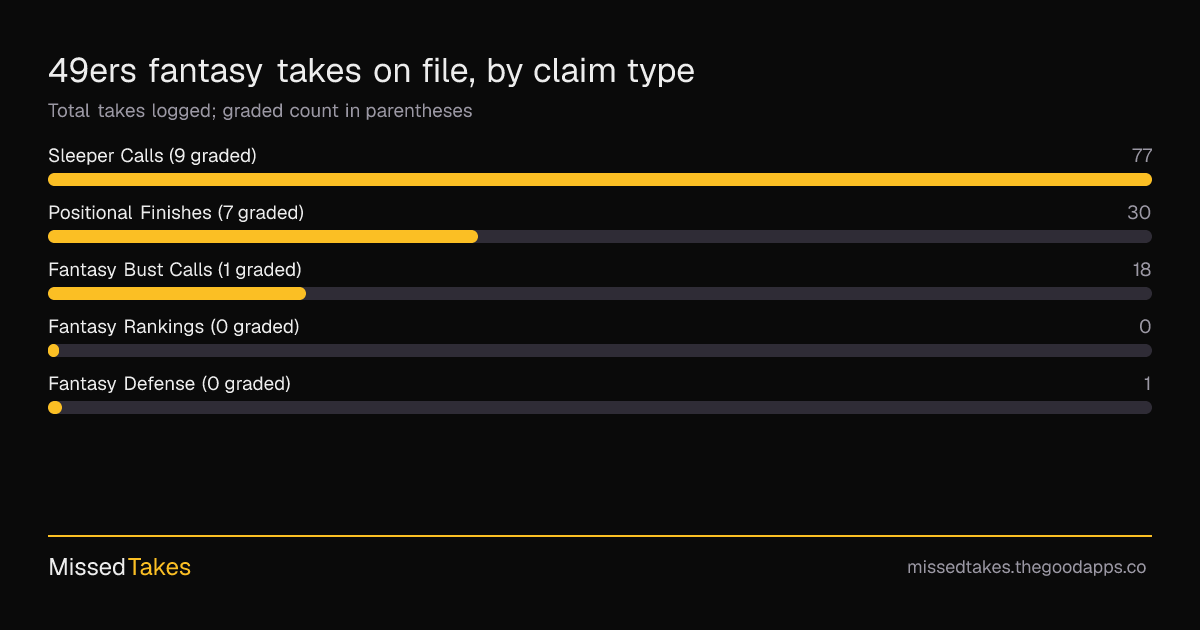
Across all claim types, wide receivers draw the most 49ers takes (165), then running backs (63), quarterbacks (46) and tight ends (40). The fantasy-specific corpus is narrower: 77 sleeper calls and 18 bust calls on 49ers players, plus 30 positional-finish claims. There are no graded fantasy-ranking calls on any 49ers player — that type has 51 graded takes site-wide and zero of them are San Francisco.
Quarterback: the field's cleanest consensus
Brock Purdy is the one 49er the fantasy industry agrees on, and the agreement is directional rather than loud: he is cheap and he shouldn't be.
- Derek Brown, repeatedly: "Purdy will again be a QB1 that goes far too late in drafts in 2026."
- Nathan Jahnke at PFF, at an ADP of 9.04: "Purdy is one of several undervalued quarterbacks available later in drafts."
- Pat Fitzmaurice has said the same thing in at least three separate August pieces: "Consider him a low-end QB1 in 2026 fantasy drafts."
- FantasyPros' projection model has him QB11 in consensus but QB8 by points, "a set-and-forget mid-range QB1 available at a streaming price." Eric Patterson goes further: Purdy "finishes as top-5 QB."
The dissent is thin. Michael Moore lists Purdy as a bust at his QB11 ranking, arguing "Purdy would need a lot of things to go right, including everyone staying healthy, to get close to a QB11 fantasy finish."
That dissent is the interesting part, because the health premise is doing the work in almost every 49ers take this summer.
Running back: nine bust calls on a man who finished RB2
Christian McCaffrey has nine bust calls logged against him for 2026 — the most concentrated fade on any 49er — and one graded sleeper/bust history that should make you read them carefully.
The arguments are uniform. Mike Fanelli, at an RB3 price: "the superstar turned 30 this offseason and is a ticking time bomb because of his age and injury history." FantasyPros' Featured Pros, three separate entries: "the odds of McCaffrey staying healthy two years in a row feel slim." Eric Karabell: "I am going nowhere near him again in 2026." Mark Morales-Smith: "He is far too risky to buy into that and draft him that high." Tom Strachan names him a player to avoid at the 1.03.
Here is the graded record on exactly that argument. The only McCaffrey bust call this site has settled is Fitzmaurice's from May 2025 — "McCaffrey is not a risk worth taking" at a second-round cost. It graded 0 accuracy, −200 skill: he finished RB2 against a bar of RB6. The two graded McCaffrey sleeper calls both scored 100.
That is one settled fade, not a body of evidence. But it is the only settled fade there is, and it went badly.
Behind him, rookie Kaelon Black is the consensus stash. Walt: "Black should be drafted late with McCaffrey's status in doubt." Walter Cherepinsky calls him "a late-round sleeper who can potentially start several games this year if McCaffrey misses time." Jahnke has him as "the slight favorite for the backup job." Note the dependency: the Black case and the McCaffrey case are the same call made from opposite ends.
Wide receiver: one name, everywhere
De'Zhaun Stribling is the most-repeated fantasy take about this team, full stop. He appears in sleeper calls from FantasyPros (multiple), Derek Brown (at least four separate pieces), Fanelli (ADP 152.2, WR57), Cherepinsky, John Breech, Henry McKenna, Zachary Pereles, Kurt Blakeway, Raju Byfield, Chris Brockman, Jahnke, Walt and Bucky Brooks. CBS's 13-writer panel put him on its All-Breakout team. Tyler Sullivan says he "may have the most productive season among all rookie WRs — Overreaction or reality: Reality."
The lone dissent on file is old and pre-camp: Brian Peacock in May said expectations "should probably not be super high for Stribling unless there's an injury." There has since been an injury — Breech's August 14 piece frames the Stribling case around "Ricky Pearsall out for the season."
Which brings up the cautionary tale. Pearsall drew seven sleeper calls last summer and all six graded ones scored 100 with +200 skill. Read the grading detail before you take comfort in that: no source named a cost, so each was measured against his own 2024 finish of WR81, and he cleared it by finishing WR78. The same player's positional-finish calls — Brown's WR26, Fitzmaurice's WR34 — both graded 0. A vague sleeper call and a specific ranking on the same player produced opposite grades. Prefer the ones with a number attached.
Now the field is fading him: Walt says he's "only an option in the final round," and PFF calls him "a credible cut candidate in all fantasy formats."
Elsewhere, Mike Evans is the genuine disagreement. Two separate writers call him a top-12 receiver — Ellis Bryn Johnson at a WR27 ADP, and an unbylined contributor promising a "top-12 wide receiver finish." Dylan Von Arx expects him to lead the team in receiving "while likely declining at age 33." Deebo Samuel is a cheap flex bet across the board: WR55 for Wolf Trelles-Heard, WR63 consensus against a WR41 projection at FantasyPros.
Tight end: the sharpest split on the roster
George Kittle is the one place the industry is openly at war with itself, and the divide runs on the calendar.
In April, three pundits torched the top-five price: Mike Florio — "I don't think I would even take him top ten, like, I want no part of this"; Marcas Grant — "I don't love the idea of taking him right after Achilles surgery"; LaQuan Jones — "a huge mistake." Kyle Zeigler in August still fades him at TE9. Walt: "No one should be drafting Kittle in the single-digit rounds," and projects 49 catches, 570 yards, 5 total TDs.
Against that: Jahnke's PFF list names him a "league winner" at ADP 7.11, Ryan Kirksey calls him "a steal at his TE9 fantasy football ADP," and Fanelli lists him a top value at TE11.
The price fell from top-five to TE9-TE11 while the argument raged, which means the two camps are now arguing about different players. Jake Ciely took the logical next step in March, ranking Jake Tonges "as a top twenty tight end because I don't think George Kittle's playing at least half."
Team defense: nothing to report
The site holds exactly one fantasy-defense call on the 49ers, and it is from July 2020 (Evan Silva ranking them DST2). The Fantasy Defense Calls type has zero graded takes league-wide. There is no basis here for a defense recommendation, and we won't manufacture one.
So how much should you trust any of this?
Three checks, all with real caveats.
By pundit. Among people making 49ers-relevant fantasy calls, with a floor of five graded takes:
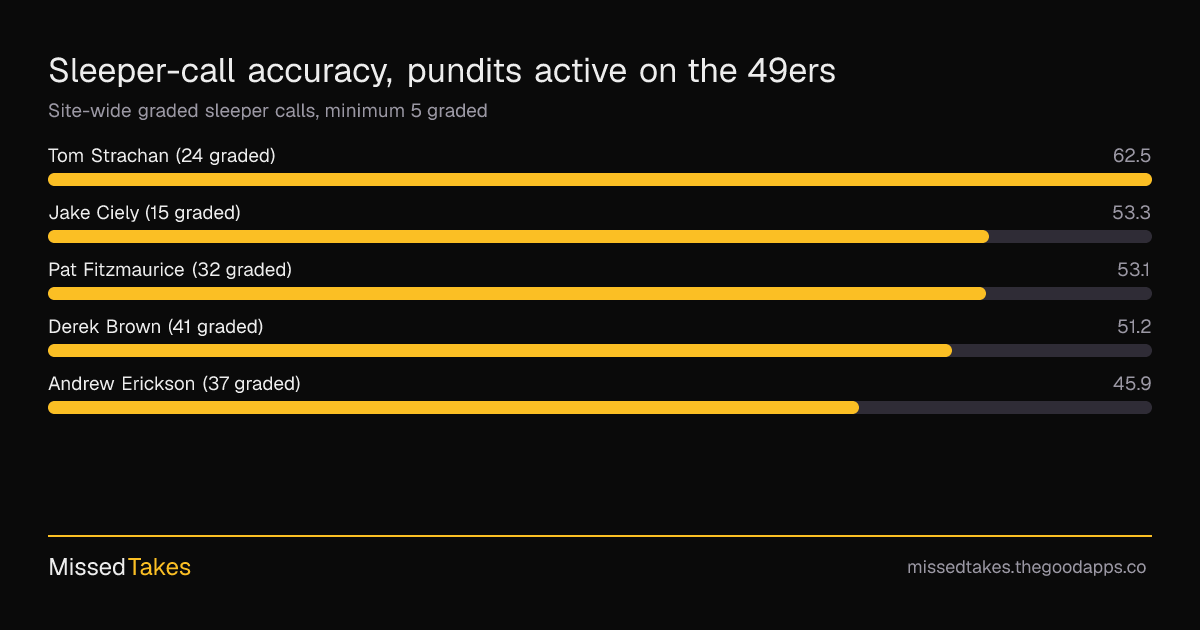
Brown is the most prolific voice on this team and his sleeper accuracy is 51.2 across 41 graded calls — a skill delta of +4.88, or barely better than the naive baseline. His bust calls are far better (75.0 accuracy, +100 skill on 16 graded). Fitzmaurice, also everywhere in this team's coverage, has the inverse problem: 53.1 on sleepers but 30.8 accuracy and −76.92 skill on 13 graded bust calls. He is one of the loudest McCaffrey faders on record and fading is the thing he grades worst at.
By position group. Site-wide graded fantasy history says sleeper calls land best at quarterback (63.9 accuracy, +57.7 skill, 36 graded) and tight end (60.9, 23 graded), and worst at running back (45.9 accuracy, −10.57 skill across 109 graded — worse than doing nothing). Positional-finish calls are worse everywhere: WR 27.5 accuracy over 102 graded, QB 34.0 over 84.
That maps uncomfortably onto this team. The Purdy consensus sits in the category that grades best. The McCaffrey pile-on sits in the one that grades worst.
By lead time. Sleeper calls made four to eight months out average 55 accuracy; inside six weeks, 42. Bust calls run 51 at four-to-eight months and 70 inside six weeks. Late bust calls have historically been better than early ones; late sleeper calls have not. Most of the Stribling wave was published in the last three weeks of August.
The short version
Purdy is the call with the best structural odds — right claim type, right position, broad agreement. The McCaffrey fade is the loudest call on the club and it is the one the graded record most directly contradicts: nine bust calls stacked on a player whose only settled fade scored zero, in the position group where fantasy calls grade below baseline. Stribling is a genuine consensus but an unusually young one, and the field's last unanimous 49ers rookie-receiver bet cleared its bar by finishing WR78.
Sample sizes throughout are small — 9 graded sleeper calls and 1 graded bust call on this entire roster. Treat everything above as a prior, not a verdict. Full detail on how these grade at Scoring methodology.