August 2026: David Harrison Wins on Skill, Marcus Mosher on Accuracy — and the Whole Ledger Settled at Once | MissedTakes Monthly
The awards
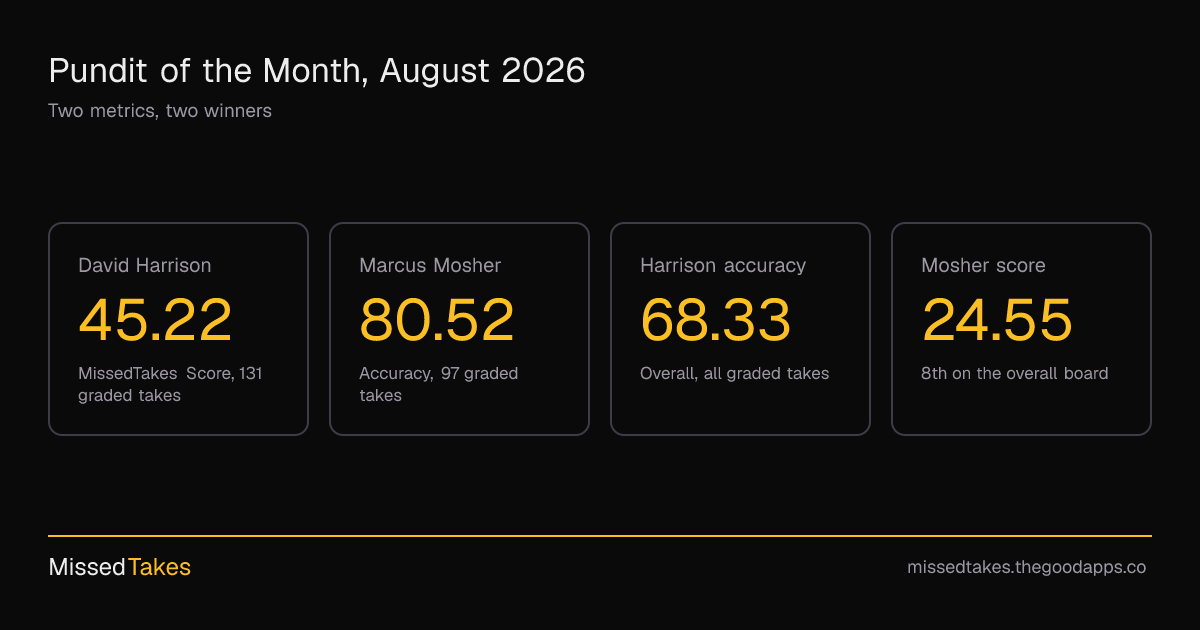
Pundit of the Month, MissedTakes Score, 2026-08: [David Harrison](/pundits/david-harrison), 45.22, over 131 graded takes drawn from 19 articles.
Pundit of the Month, Accuracy, 2026-08: [Marcus Mosher](/pundits/marcus-mosher), 80.52, over 97 graded takes drawn from 16 articles.
Two names, two metrics, and the split is the point. The MissedTakes Score measures how much better than a naive baseline a call was; accuracy just asks whether the call was right. Harrison won the first and finished 68.33 on the second. Mosher won the second and sits at a 24.55 score, eighth on the board.
One caveat up front, and it's a large one. August is the month this ledger settled. Every take we sampled while researching this piece carries a grading date between August 5 and August 19, 2026 — the 2026 draft, the 2025 season, and a backlog of 2024 calls all resolved in the same stretch. Both winners' August samples are identical in size to their full published records (131 for Harrison, 97 for Mosher), which means the monthly board and the all-time board are, for now, nearly the same document. Treat "August" here as "the first full accounting," not as a month of fresh work.
Harrison: right about the top of the draft, wrong about the bottom
Harrison's 131 graded takes are 120 mock-draft picks, four position-order calls, four trade-and-signing calls, two Super Bowl picks and one team draft-slot call. The mock picks score 64.04 accuracy and 43.24 skill, which puts him fourth among graded mock drafters by score, behind Chris Brockman (50.00 on 36 picks), John Middlekauff (50.00 on 19) and Rich Eisen (46.67 on 58). Harrison's edge is volume: 120 graded picks against their 36, 19 and 58.
The four position-order calls all landed at 100 accuracy and 82.38 average skill — Mansoor Delane as CB1 (+87.36 skill against a 12.64 baseline from a 27-man class), Jeremiyah Love as RB1, and in his one full first-round mock, Spencer Fano as the first tackle and Jordyn Tyson as the second receiver. Small sample, four calls, but four for four.
His two Super Bowl picks were the same pick made twice: Seattle, in February, when the naive pick was Philadelphia. Seattle won. Both takes graded 100 accuracy, +100 skill.
Where he lost: trade-and-signing calls, 50 accuracy and a -50 score across four takes, dragged down entirely by a proposed Daron Payne-for-Maxx Crosby swap with Las Vegas. Crosby stayed a Raider, Payne stayed a Commander, and both legs graded 0 accuracy and -100 skill against a baseline that simply assumes players stay put.
Then there's the Day 3 problem, which is not really his problem. Of his 39 graded misses, most are late-round Washington projections that never happened: Roman Hemby at 223 in three separate mocks, Cade McDonald at 29, Jermott McCoy at 18 — all undrafted, all 0 accuracy. Note the scoring quirk worth understanding: the McCoy pick graded 0 for accuracy but +45 for skill, because the surrounding mock's ordering still beat a shuffled board. A pundit can be badly wrong about a player and still beat the baseline on the exercise.
Mosher: the accuracy title, and what accuracy is made of
Mosher's 80.52 is the highest monthly accuracy on the board, and his by-type record explains most of it. Depth-chart calls: 95.19 accuracy over 19 takes — and a skill score of -0.94. Playoff picks: 85.19 over 17, skill +16.91. Power rankings: 84.76 over 10. Those are claim kinds where the obvious answer is usually the right one; site-wide, depth-chart calls grade 93.5 accuracy on 415 graded takes and add just +1.82 in skill.
The genuinely valuable part of his month came from 13 sleeper calls: 66.67 accuracy, and 66.67 skill. Three 2024 breakout picks — Will Levis and Drew Lock, plus Cade Otton — each graded 100 accuracy and +200 skill, though the margins were thin: Lock finished QB39 against a QB48 bar, Levis QB30 against QB32.
Against that, division winners cost him: 10 graded, 59.52 accuracy, -13.5 skill, because picking last year's division champion is exactly the naive baseline. Two conference-champion calls sit at -94.5.
The field in August
Across the 27 claim kinds with at least ten graded calls, the site now holds 8,322 graded takes. Roughly 3,100 of all graded takes fall in the miss band, under 40.
The type-level splits are unflattering in places and forgiving in others:
| Claim kind | Graded | Avg accuracy | Avg skill |
|---|---|---|---|
| Mock Draft Picks | 2,913 | 64.4 | +36.09 |
| Game Outcome Picks | 1,070 | 59.7 | +3.21 |
| Playoff Picks | 486 | 59.5 | +13.18 |
| Depth Chart Calls | 415 | 93.5 | +1.82 |
| Award Picks | 354 | 21.2 | +25.29 |
| Division Winners | 351 | 27.4 | +19.64 |
| Trade and Signing Calls | 349 | 51.3 | -15.07 |
| Conference Champions | 187 | 25.1 | +6.66 |
| Pro Bowl and All-Pro Calls | 65 | 0.0 | -98.22 |
Award picks illustrate the gap between the two metrics as cleanly as anything: 21.2 accuracy, +25.29 skill. Pundits are almost always wrong about awards, and still slightly better than a coin flip that names last year's winner. Pro Bowl and All-Pro calls are the one category with zero — literally 0.0 average accuracy across 65 graded takes, and -98.22 skill.
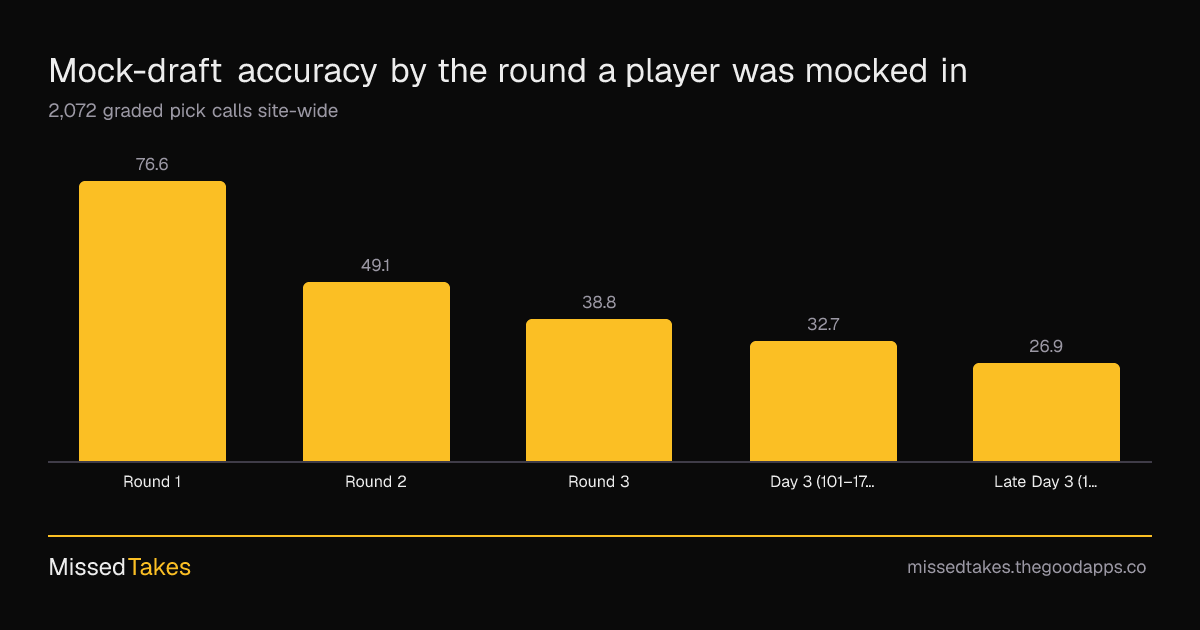
Mock drafting keeps its familiar shape. Round-one projections grade 76.6 accuracy across 1,619 picks with an average miss of about ten slots; by late Day 3 that falls to 26.9 accuracy and a miss of nearly 50 picks.
The case study's most-missed player list is led by Jermod McCoy — 21 mocks, average slot 16, actual pick 101 — and Shedeur Sanders, mocked 15 times at an average of ninth overall and drafted 144th.
How the month moved the standings
Because the whole backlog graded at once, the August board *is* the leaderboard: Harrison first at 48.77, Lance Zierlein second at 43.01 on 37 graded takes, Derek Brown third at 35.62. Mosher's accuracy title puts him eighth by score.
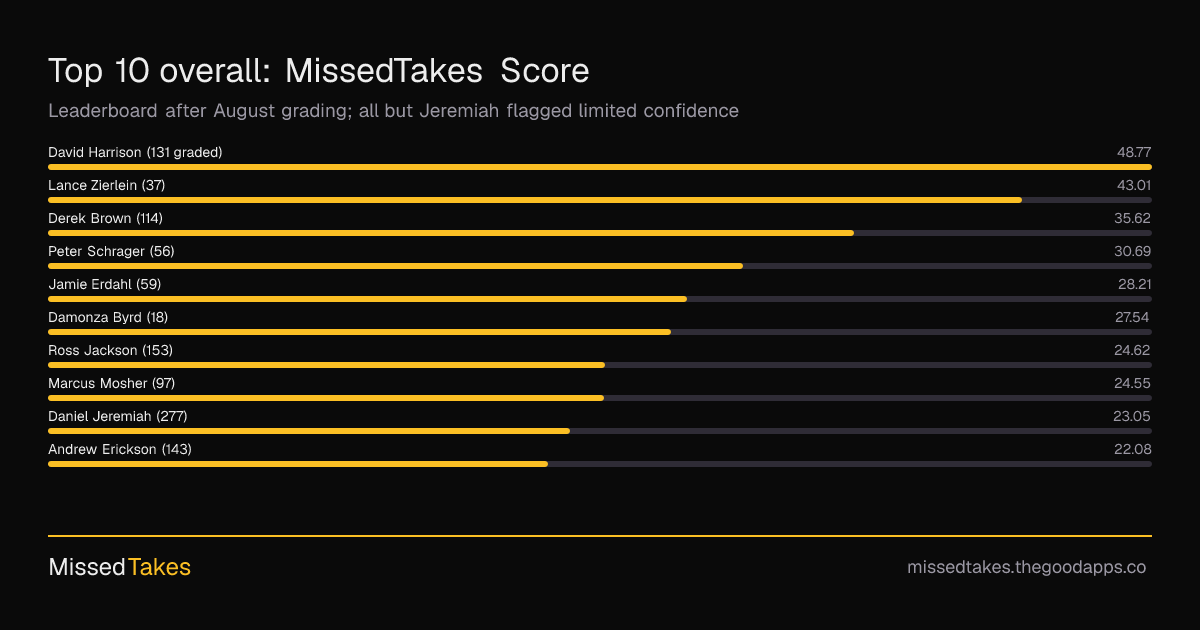
The honest reading: eleven of the top twelve records carry a limited confidence flag. Only Daniel Jeremiah, ninth at 23.05 with 277 graded takes across 39 articles, is marked established. Zierlein's 43.01 rests on 37 calls. Harrison's 131 is a real sample, but 120 of them are mock-draft picks from a single draft cycle, which is one event, not a track record.
So: congratulations to both winners, with the asterisk that a first accounting is not a career. The next month with independent grading — takes claimed after this backlog, resolved on their own schedule — is the one that will tell us whether these two are good or merely first.