Atlanta Falcons Fantasy Preview 2026: Pundits Are 22.7 Accurate on This Receiver Room
The Falcons went 8-9 in 2025, their third straight season without the playoffs, and enter 2026 with Kevin Stefanski as head coach and a quarterback room that nobody in our database is willing to draft. That combination produces a specific kind of punditry: heavy volume on the depth chart, near-unanimity on the running back, and a receiver room that has burned the field two years running.
Here is what the graded record says about the takes you are hearing right now.
Where the punditry actually points
By raw volume, Atlanta's most-discussed positions are receiver (61 takes) and quarterback (58), then tight end (28) and — despite housing the most valuable fantasy asset on the roster — running back (19). Accuracy on those groups splits sharply.
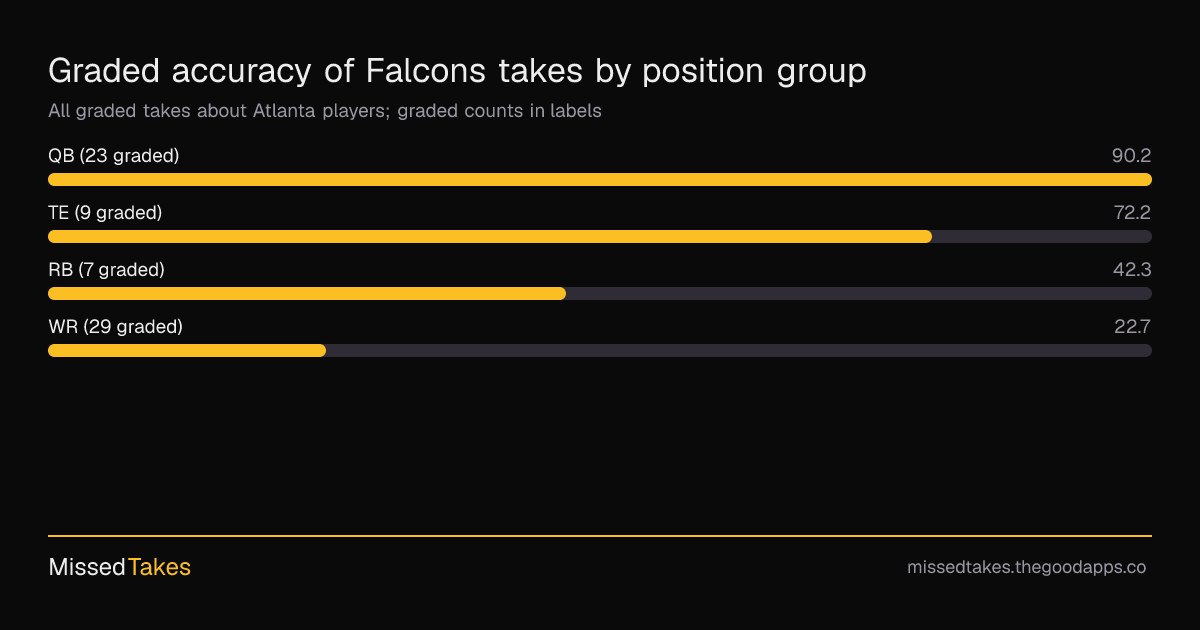
The quarterback number is high because those takes are almost all depth-chart calls, which grade easy site-wide. The receiver number is the story of this post.
Quarterback: a settled competition and no fantasy case
The field has converged on Tua Tagovailoa opening the season while Michael Penix Jr. rehabs a torn ACL. CBS's Tyler Sullivan put it as a flat prediction — "Tua Tagovailoa wins the Week 1 job" — and Bucky Brooks, Kevin Patra, Michael David Smith and PFF's preview all landed the same way. Bradley Locker's PFF preseason piece called Tagovailoa "the favorite to open as Atlanta's starting quarterback." Nobody in the database is arguing otherwise.
Fantasy-wise the room is priced accordingly: the only projection we hold is Walt's WalterFootball line for Penix — 3,600 passing yards, 23 touchdowns, 13 interceptions, 236 fantasy points — published inside a ranking of quarterbacks 21 through 35.
Worth noting how low the bar is on Atlanta quarterback sleeper calls. Chris Brockman ("Take Michael Penic's late") and Jason Cabinda both graded 100 with +200 skill on Penix last year — the grade needed him to beat QB47, and he finished QB33. Mike Harmon's Kirk Cousins revival call graded 0: Cousins finished QB35 against a QB23 bar.
Running back: everyone is right about Bijan, which earns nothing
Five separate voices this offseason have called Bijan Robinson the best back in football — Ralph Vacchiano, Brooks (he "just barely edges out Jahmyr as the NFL's best running back right now"), Bryan DeArdo, Jeff Cavanaugh and JP Acosta.
The grading arithmetic explains why consensus is cheap. When Pat Gustavson and Acosta made the same claim in January, both scored 75 accuracy but *negative* skill (-16.67): Robinson had finished third in rushing yards the year before, so the naive baseline was already 91.67 and finishing fourth was a small step back. The Bijan call that actually earned credit was Ryan Wormeli's May 2025 league-winner take at the third or fourth pick — 100 accuracy, +200 skill, RB3 finish against an RB4 bar. The one that blew up was Damonza Byrd's rushing-touchdown-lead pick: Robinson finished 20th in rushing scores, graded 0.
Behind him, Brian Robinson is a one-line take. Jeremy Munter recommends him as a handcuff who "will vulture some TDs here and there... You can draft him near the end of every draft," and Vacchiano simply lists him as "the backup running back." That is the entire fantasy case in our records.
Wide receiver: the group with the worst graded history on the team
Twenty-nine graded takes about Falcons receivers average 22.7 accuracy and -55.0 skill. Drake London alone accounts for 19 of them at 17.5 accuracy.
The mechanism is simple: the field kept pricing him as a top-five receiver and he kept finishing outside it. Andrew Erickson went to "the wide receiver one overall, that is my mile take," Derek Brown said "London could be the wide receiver one overall this year," LaQuan Jones had him cracking the top five, Wormeli ranked him WR5. London finished WR17. The round-two sleeper versions of that call — Erickson's and Brown's — each graded 0 with -200 skill, because the naive view (repeat WR6) already beat the outcome.
Darnell Mooney was worse: four graded takes, 0.0 accuracy, -200 skill on every one. Tom Strachan, Chris Welsh ("sneaky wide receiver three upside... going as like a wide receiver five"), Joe Dolan and Pat Fitzmaurice all bought the discount. He finished WR80.
For contrast, the single best receiver call we hold on this club is Marcus Mosher's 2024 London breakout — 100 accuracy, +200 skill, WR42 bar, WR6 finish. Same player, same argument, two years apart, opposite results.
The 2026 board is genuinely split. FantasyPros' featured pros list London as a fade: "At this price, the risk outweighs the reward, making him an easy fade for me." Greg Auman goes the other way, arguing Stefanski is "London's first really good offensive-minded coach, so it's easy to envision him getting double-digit touchdowns for the first time."
Rookie Zachariah Branch is the pile-on: five separate sleeper takes since August 2, including Jim Moorman ("In the 15th round, Branch provides a fantasy ceiling very few have in this range of the draft") and Walt, who has him at an ADP of 20.05 and expects him to start in the slot. The dissent is PFF's, twice: Nathan Jahnke says Branch "shouldn't be one of them because his upside appears limited," and Gordon McGuinness writes "don't be shocked to see rookie third-round draft pick Zachariah Brand finish fourth on this team in targets." Jahnke and McGuinness instead push Jahan Dotson as the WR2 and "worth a late-round pick in deeper leagues."
Tight end: Pitts is the most contested name on the roster
Kyle Pitts finished TE3 in 2025 — which is how Wormeli's December top-five call graded 83.33 with +68.25 skill, and how Cynthia Frelund's "I am staying away from Kyle Pitts in every single fantasy league" graded 0 with -200 skill against a TE12 bar.
That result has not settled anything. On the bullish side, Fitzmaurice has hit Pitts three times, most recently noting he's "being drafted in the seventh round" while "the tight ends in Stefanski's Cleveland offenses averaged 164.3 targets over the last three seasons," and FantasyPros projects him TE5 against a TE8 consensus. On the fade side, Jake Ciely ("I would be off Kyle Pitts"), Eric Karabell's Do Not Draft list, and Brandon Carney at full volume: "He's average. Shut up. Don't draft Kyle Pitts."
The widest gap is between projection systems, not personalities: FantasyPros has him at 156.0 projected points and TE5; WalterFootball's tight end 21-44 list gives him 93 points on 50 catches, 630 yards and five scores.
Team defense: nothing
We hold five fantasy defense calls in the entire database, none of them about Atlanta and none of them graded. There is no punditry here to grade.
How much should you trust any of this?
Start with the sample, because it is small. Atlanta's fantasy-specific graded record is 14 sleeper calls and 2 bust calls — plus zero graded fantasy-ranking calls and zero defense calls. Anything below is an estimate carrying that caveat.
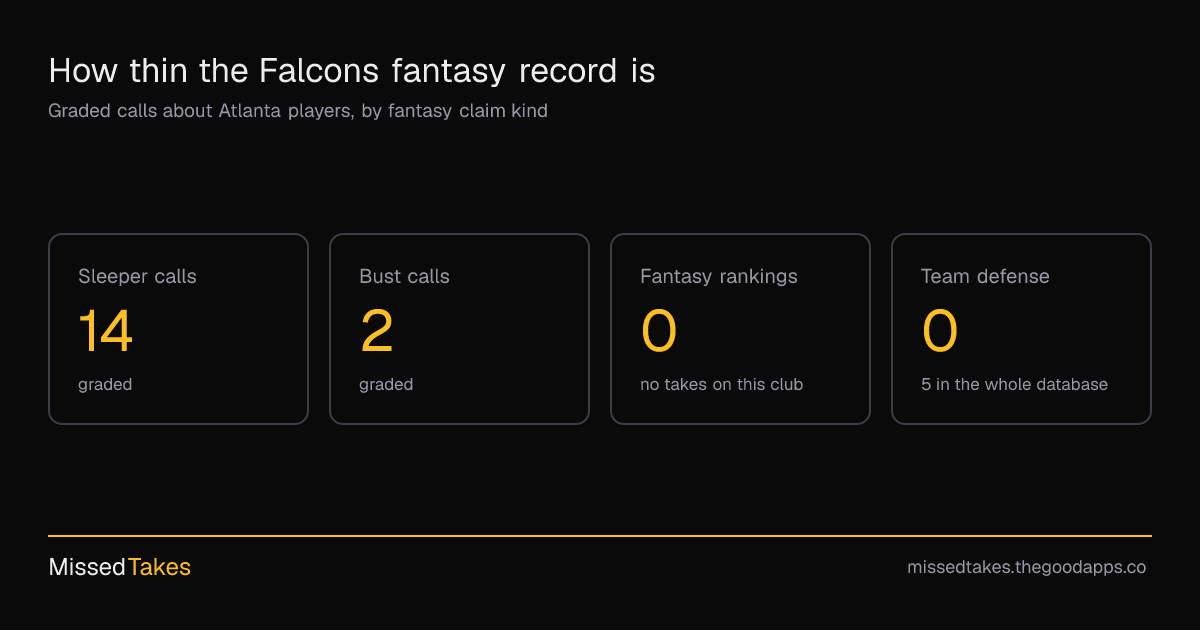
Site-wide, sleeper calls grade best at quarterback (63.9 accuracy, 36 graded) and tight end (60.9, 23), then receiver (52.2, 134) and running back (45.9, 109). Bust calls run higher at receiver (64.3, 42 graded) and back (55.6, 27) and worse at tight end (42.9) — though that tight end figure rests on seven graded calls and should not be leaned on.
At the individual level, the people making Atlanta's calls have uneven records:
| Pundit | Sleeper calls | Bust calls | Overall accuracy |
|---|---|---|---|
| Derek Brown | 52.25 (41) | 77.08 (16) | 62.71 |
| Pat Fitzmaurice | 59.20 (32) | 22.86 (13) | 51.32 |
| Andrew Erickson | 44.67 (37) | 88.89 (11) | 57.03 |
| Jake Ciely | 26.67 (15) | 25.00 (5) | 57.62 |
Read that against who is saying what. Fitzmaurice, the loudest Pitts backer, has the site's weakest graded record at telling you who *not* to draft; Ciely, on the other side of Pitts, has 5 graded bust calls at 25.0 accuracy. Erickson's bust record is strong and his positional-finish record is not (29.34 across 38 graded) — and the London-as-WR1 calls were positional finishes.
Finally, waiting does not help. Sleeper calls made inside six weeks of resolution average 42 accuracy (26 graded) versus 55 for those made four to eight months out (211). Positional-finish calls sit between 32 and 38 at every lead time we measure. Late-August confidence is not better-informed confidence.
The short version for a drafter: the Bijan consensus is correct and worth nothing extra, the Pitts disagreement is real and the graded evidence tilts against the fade crowd, and every strong opinion about this receiver room deserves the discount its two-year track record has earned.